The Roman
carbonara recipe.
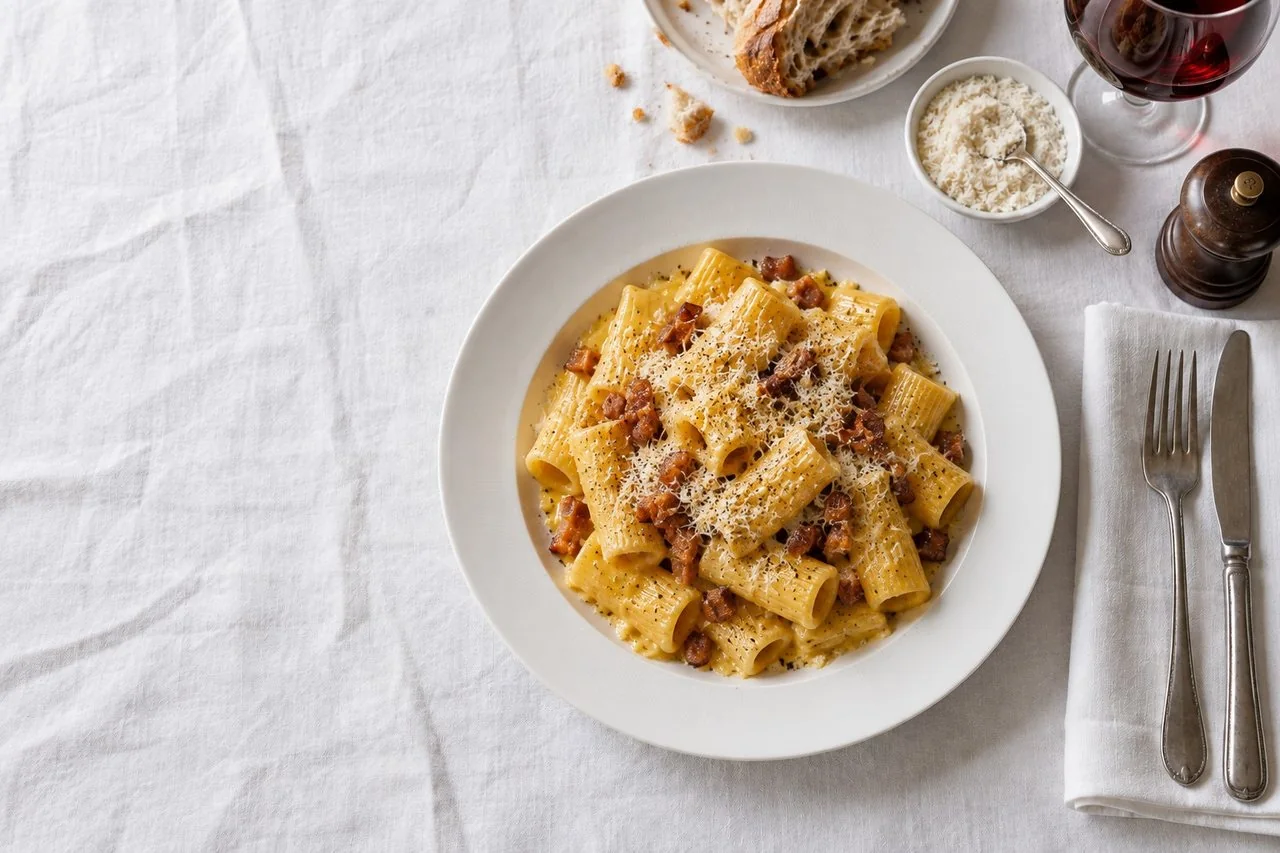
Roman carbonara takes five ingredients: pasta, guanciale, egg yolks, Pecorino Romano and black pepper, and no cream. In the four published recipes we compare, each person needs 80–100 g of pasta, 20–50 g of guanciale, 20–25 g of cheese and one egg yolk; the calculator below scales the quantities to your number of people.
How much per person? Four recipes compared.
There is no official carbonara quantity: every cook has their own. We lined up four published recipes, two from Roman cooks and Italian food sites and one from the Pecorino Romano Consortium, with the quantities exactly as written and a last row with the per-person median. The biggest differences are in the guanciale (20 to 50 g per person) and the eggs (yolks only, or yolks plus one whole egg).
All the Roman dishes in one table, with seasons and protected products: traditional Roman dishes.
The amatriciana recipe, with the TSG specification shares and a calculator, is on the traditional amatriciana recipe.
| Recipe (source) | Serves | Pasta | Guanciale | Cheese | Eggs |
|---|---|---|---|---|---|
| Scatti di Gusto, “scientific recipe” (2025) | 4 | 360 g | 100 g guanciale | 100 g Pecorino Romano | 4 egg yolks |
| Luciano Monosilio, Scatti di Gusto (2018) | 2 | 160 g | 40 g guanciale | 30 g Pecorino Romano + 20 g Parmigiano Reggiano | 2 egg yolks |
| Dissapore (2019) | 4 | 400 g | 200 g guanciale | 6 tablespoons Pecorino Romano | 3 egg yolks + 1 whole egg |
| Pecorino Romano DOP Consortium | 4 | 400 g | 200 g bacon + 2 tbsp olive oil | 80 g Pecorino Romano | 4 egg yolks |
| Median per person (our calculation) | 1 | 95 g | 37.5 g | 25 g | 1 egg yolk |
Quantities read on 14 October 2026 on the linked pages (all in Italian except the Consortium’s English page). The median is our own per-person calculation over the four recipes; Dissapore gives the pecorino in tablespoons, so it is left out of the cheese median. The Consortium uses bacon and oil, not guanciale.
Work out the quantities for your table.
Choose the median of the four recipes or a single source, enter how many people you are cooking for, and you get grams and eggs already rounded. It is arithmetic on the published quantities: taste and adjust salt and pepper.
The ingredients, one by one.
Guanciale. Cured pork cheek, fattier and more flavourful than pancetta: its rendered fat is the dressing, so no oil is needed. Scatti di Gusto recommends guanciale aged at least 60 days.
Pecorino Romano. A salty sheep’s-milk cheese, which is why the pasta water needs only a little salt. Monosilio uses part pecorino and part Parmigiano Reggiano.
Eggs. Today’s version uses yolks; Italian Wikipedia notes that some cooks add one whole egg for every two yolks, and Dissapore uses 3 yolks and 1 egg for four.
Pasta and pepper. Spaghetti or rigatoni: a short ridged pasta holds the sauce better. Grind the black pepper fresh.
How to make it, step by step.
1. The guanciale. Remove the rind, cut it into strips and fry it without oil over medium heat until the fat turns translucent and the outside is crisp. Keep it aside with its fat.
2. The sauce. In a bowl, whisk the yolks with the grated pecorino and pepper into a thick cream.
3. The pasta. Cook it in lightly salted water and drain it al dente, keeping some of the cooking water.
4. Off the heat. Toss pasta, guanciale fat and egg cream quickly, loosening with a spoonful of cooking water. According to Scatti di Gusto the yolk starts to thicken at around 65 °C: above that it sets and the sauce scrambles.
5. To finish. Add the crisp guanciale, more pepper and pecorino to taste. Serve at once.
Cream, pancetta, garlic: the history in five dates.
23 August 1939. The Dutch-Indonesian daily De Koerier mentions “spaghetti alla carbonara” in a Trastevere trattoria, with no recipe (source: Italian Wikipedia).
1 May 1948. Renato Mucci writes about it in Il Giornale di Trieste, still without ingredients.
August 1954. La Cucina Italiana prints the first Italian recipe: pancetta, gruyère and garlic, plus eggs and pepper (Il Sole 24 Ore).
From the late 1990s. The recipe settles into the one we know: guanciale, yolks, Pecorino Romano, pepper, no added fat and no cream.
Since 2017, every 6 April. The pasta makers of Unione Italiana Food hold Carbonara Day; 2024 was the eighth edition.
Before you visit
How many eggs for carbonara?
In three of the four recipes compared, one yolk per person: 4 yolks for four people. Dissapore uses 3 yolks and 1 whole egg for four.
How much guanciale per person?
From 20 g (Monosilio) to 50 g (Dissapore, and the Consortium, which uses bacon). The median of the four recipes is 37.5 g per person, our own calculation.
Does carbonara have cream?
Today’s Roman recipe does not: the sauce comes from yolks, pecorino and a little pasta water. The first published recipe, in La Cucina Italiana in August 1954, used gruyère and garlic instead.
Guanciale or pancetta?
The Roman version uses guanciale. The Pecorino Romano Consortium’s English recipe uses bacon and two tablespoons of oil.
How do I stop the eggs scrambling?
Toss off the heat, quickly, with a spoonful of pasta water: according to Scatti di Gusto the yolk starts to thicken at around 65 °C.
Where can I eat carbonara near Termini?
At La Lupa, Via Marghera 37, about a hundred metres from the Via Marsala exit: rigatoni with guanciale, pecorino and egg, kitchen open 12:00–23:00. Details on carbonara near Termini.