The traditional
amatriciana recipe.
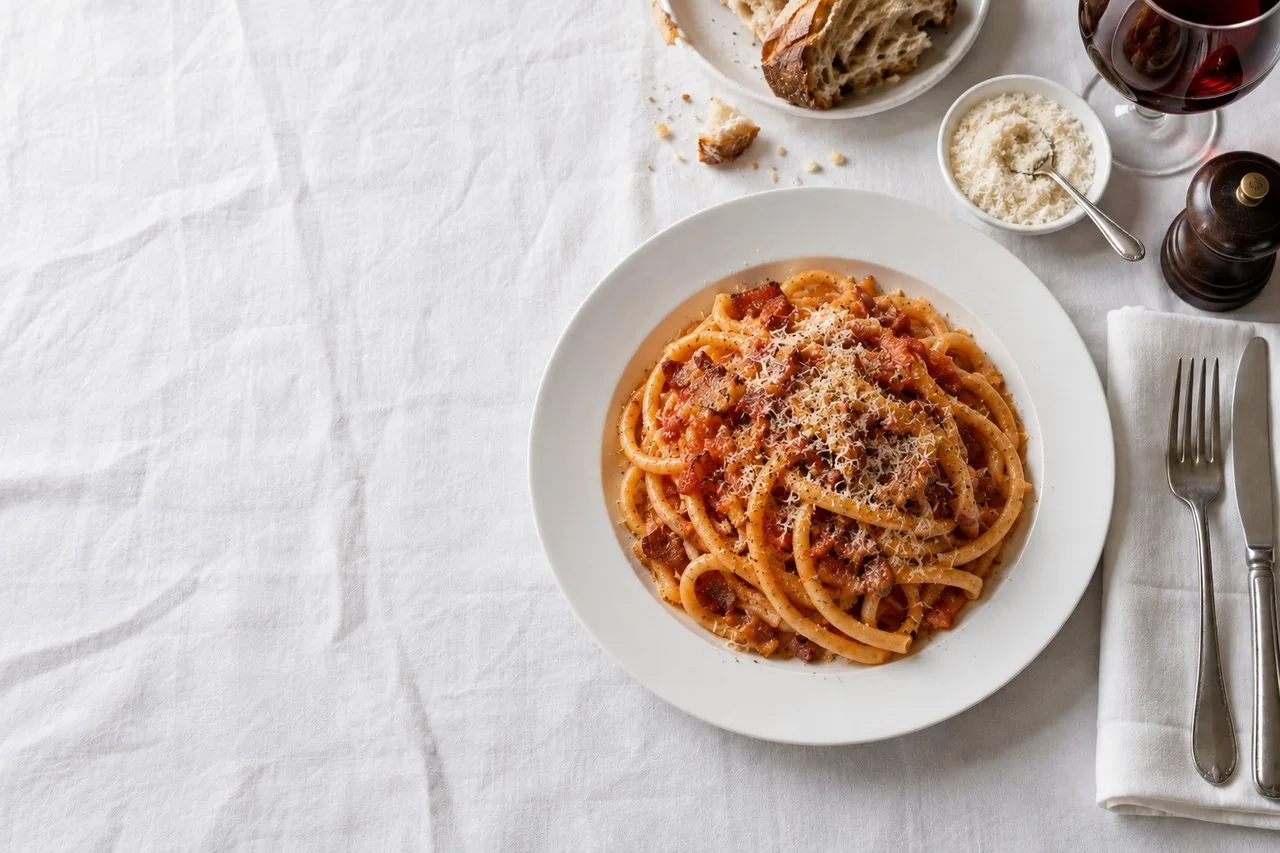
Since 13 March 2020 traditional amatriciana has been a TSG, a recipe registered in the European Union. Its specification asks for guanciale (18 to 30% of the finished sauce), tomato passata or peeled tomatoes (69 to 81%), extra virgin olive oil (0.5 to 1%), white wine, salt and chilli or pepper. It excludes garlic, onion and pancetta and recommends grated pecorino on the plate. The calculator below scales the quantities to the pasta you are cooking.
What the TSG specification says, ingredient by ingredient.
The «Amatriciana tradizionale» specification, published in the Italian Gazzetta Ufficiale on 8 April 2020, gives no grams: it gives shares of the weight of the finished sauce. In 500 g of finished sauce, for example, there are 90 to 150 g of guanciale and 345 to 405 g of tomato. Salt, white wine and chilli or pepper are «to taste».
| Ingredient | Share | What the specification requires |
|---|---|---|
| Guanciale «del tipo amatriciano» | 18–30% | Cheek of heavy pigs trimmed into a triangle, cured at least 30 days from salting |
| Tomato passata and/or peeled tomato pieces | 69–81% | No added acidifiers |
| Extra virgin olive oil | 0.5–1% | Used to fry the guanciale |
| White wine | to taste | Added after the guanciale has browned |
| Salt | to taste | — |
| Dried or fresh chilli and/or pepper | to taste | — |
| Grated Amatrice-type pecorino or Pecorino Romano DOP from Lazio | recommended | On the finished pasta; Amatrice-type pecorino is aged at least 6 months |
| Garlic, onion, pancetta | excluded | The specification says traditional amatriciana does not use them |
Source: specification published in the Italian Gazzetta Ufficiale no. 93, 8 April 2020 (in Italian), read on 17 October 2026. «To taste» translates «q.b.» (quanto basta); shares are of the weight of the finished sauce.
Two published recipes, with their original quantities.
The specification itself quotes the recipe of the Pro Loco of Amatrice: 500 g of spaghetti for 5–6 people. We set it next to the one published by VisitLazio, the Lazio Region’s tourism portal. Guanciale and tomato match (125 g and 400 g); the pecorino differs, 100 g against 150 g.
| Recipe (source) | Pasta | Guanciale | Tomato | Pecorino | Oil, wine, chilli |
|---|---|---|---|---|---|
| Pro Loco of Amatrice, quoted in the specification | 500 g spaghetti, serves 5–6 | 125 g | 400 g peeled tomatoes or 6–7 San Marzano tomatoes | 100 g | 1 tbsp extra virgin olive oil, a drop of dry white wine, a small piece of chilli |
| VisitLazio (Lazio Region) | 500 g spaghetti | 125 g | 400 g | 150 g | Oil and wine in the method, no quantity; chilli optional |
The Pro Loco recipe is quoted in the specification as given by Livio Jannattoni in «La cucina romana e del Lazio» (1998). Quantities read on 17 October 2026.
Work out the quantities for your pasta.
Enter how much pasta you are cooking and pick a recipe: guanciale, tomato, pecorino and oil scale in proportion. With 500 g of pasta the Pro Loco recipe serves 5–6, which is 83 to 100 g each. It is arithmetic on the published quantities: taste and adjust the salt and chilli.
How to make it, following the specification.
1. The guanciale. Remove the rind and cut it into strips. Fry it in extra virgin olive oil over low heat until the foam the guanciale gives off has gone.
2. The wine. Then add the white wine. When the strips are golden yellow, take them out of the pan and set them aside.
3. The tomato. In the same pan, add the passata or peeled tomatoes, salt and chilli or pepper. Cook over high heat for 10–20 minutes from the boil, until the sauce is creamy.
4. The guanciale again. Put the strips back into the sauce and cook for another 5–10 minutes.
5. The pasta. Traditionally spaghetti or bucatini, but the specification also allows short pasta. Toss and finish with grated pecorino. VisitLazio browns the guanciale over high heat; the specification says low.
No onion, garlic or pancetta: why.
The specification says that traditional amatriciana, unlike other pasta sauces, uses no garlic, onion or pancetta, and that it is made only with the listed ingredients and quantities. The reason for guanciale is its fat: according to the text, guanciale, fattier than pancetta, is what gives the sauce its intense, savoury taste. The tomato has rules too: no added acidifiers.
Pecorino is recommended, not required: the Amatrice type, aged at least 6 months, or Pecorino Romano DOP from Lazio. The other Roman dishes made with pecorino are in our guide to traditional Roman dishes.
From Laga shepherds to Rome’s taverns.
Centuries of transhumance. The specification tells how the shepherds of the Monti della Laga spent 4–5 months away from home, usually May to September, carrying guanciale and flour.
Late 1700s to early 1800s. In Amatrice, part of the Kingdom of Naples since the 13th century, tomato joins the guanciale.
The 1800s. Many people from Amatrice who moved to Rome worked as innkeepers and grocers, and that is how the sauce reached the city’s taverns.
28 July 2005 and August 2008. «Salsa all’Amatriciana» joins Italy’s list of recognised traditional products (Gazzetta Ufficiale no. 174); three years later an Italian «Made in Italy» stamp celebrates the Amatrice spaghetti festival.
2018 to 2020. Application filed on 31 January 2018, published in the EU Official Journal on 20 November 2019, registered as a TSG on 13 March 2020 (eAmbrosia register).
Before you visit
Does amatriciana have onion?
No. The specification of the «Amatriciana tradizionale» TSG excludes garlic, onion and pancetta and says to use only the listed ingredients.
Guanciale or pancetta?
Guanciale: the specification says amatriciana has always been made with guanciale and never with pancetta. It is 18 to 30% of the weight of the finished sauce.
How much guanciale for 500 g of pasta?
125 g, both in the Pro Loco of Amatrice recipe quoted in the specification and in VisitLazio’s recipe.
Spaghetti or bucatini?
Either: the specification names spaghetti or bucatini as the traditional pasta and also allows short pasta. The Pro Loco recipe uses spaghetti.
What does TSG mean?
Traditional Speciality Guaranteed: it protects a recipe or a method, not a place of production. «Amatriciana tradizionale» has been a TSG since 13 March 2020; a sauce sold under that name must follow the specification.
Where can I eat amatriciana near Termini?
At La Lupa, Via Marghera 37, about a hundred metres from the Via Marsala exit: bucatini with guanciale, tomato and pecorino, kitchen open 12:00–23:00. Details on amatriciana near Termini.