Traditional
Roman dishes.
Roman cooking is four pastas (carbonara, cacio e pepe, amatriciana and gricia), the «fifth quarter» such as oxtail and tripe, fried starters like supplì and Jewish-style artichokes, and a few seasonal vegetables. Below are 17 dishes in one table: course, ingredients, the ingredient or recipe protected by the European Union, the season, and which ones you will find on the menu at La Lupa, near Termini.
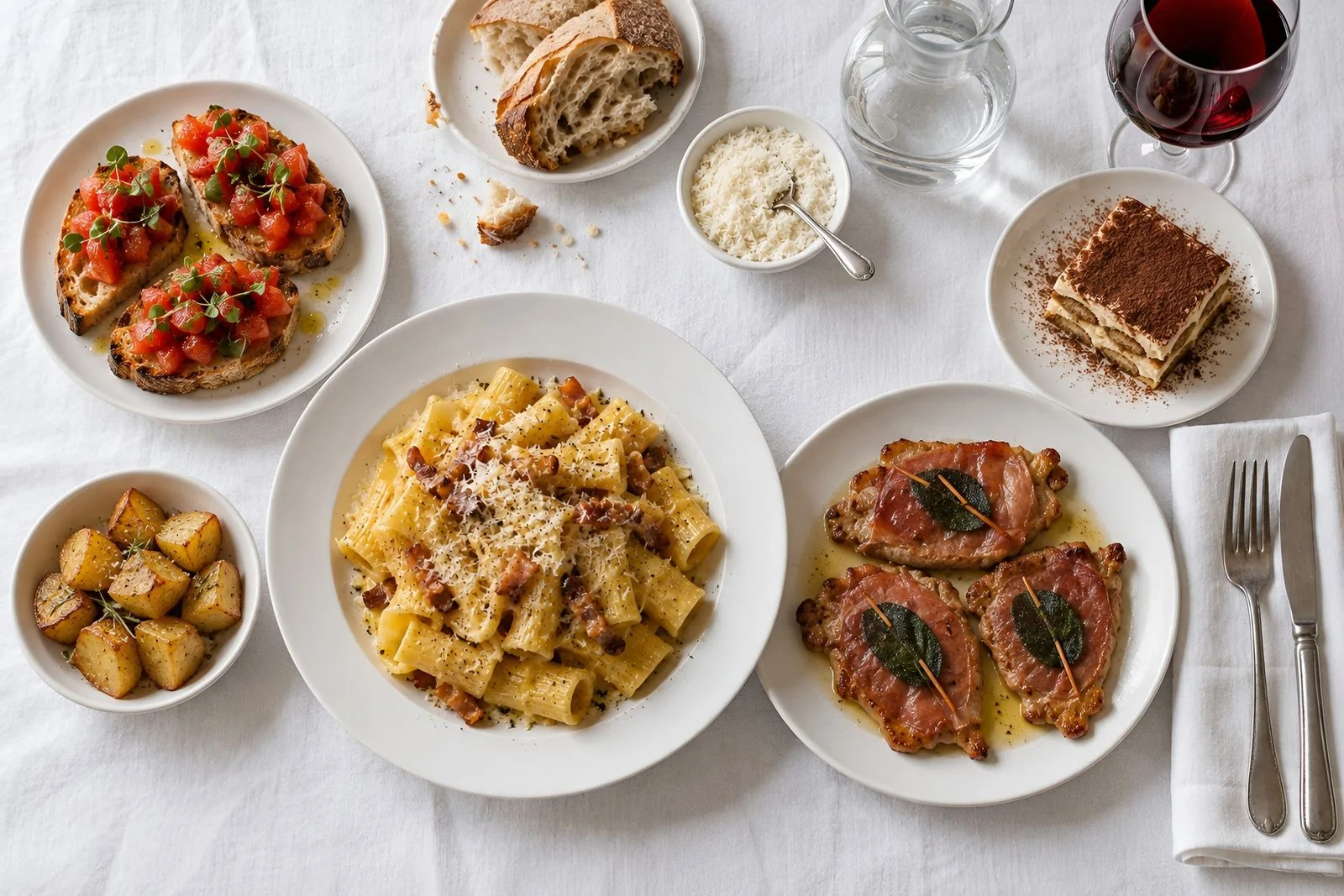
The 17 Roman dishes in one table.
Each row says what the dish is, when it is eaten and whether its main ingredient has a protected name in Europe. Almost all Roman pastas share pecorino romano, a PDO since 1996; amatriciana is the only registered recipe. Use the filter to show one course or only the dishes you can order at La Lupa.
The amatriciana recipe, with the TSG specification shares and a calculator, is on the traditional amatriciana recipe.
| Dish | Course | Ingredients | EU-protected ingredient or recipe | When | On La Lupa’s menu |
|---|---|---|---|---|---|
| Carbonara | Pasta | egg yolks, guanciale, pecorino romano, black pepper | Pecorino Romano PDO, since 1996 | all year | Yes · our page |
| Cacio e pepe | Pasta | pecorino romano, black pepper, pasta (often tonnarelli) | Pecorino Romano PDO, since 1996 | all year | Yes · our page |
| Amatriciana | Pasta | guanciale, tomato, pecorino, white wine, chilli | «Amatriciana tradizionale» TSG, since 2020; Pecorino Romano PDO, since 1996 | all year | Yes · our page |
| Gricia | Pasta | guanciale, pecorino romano, black pepper | Pecorino Romano PDO, since 1996 | all year | Yes · our page |
| Thursday gnocchi | Pasta | potatoes, eggs, flour | — | Thursdays | No |
| Coda alla vaccinara (oxtail) | Main | oxtail, tomato, celery, white wine | — | — | No |
| Trippa alla romana (tripe) | Main | tripe, tomato, onion, Roman mint, pecorino romano | Pecorino Romano PDO, since 1996 | Saturdays | No |
| Saltimbocca alla romana | Main | veal, prosciutto, sage, butter, white wine | — | all year | Yes · our page |
| Abbacchio (milk-fed lamb) | Main | grilled chops (scottadito) or braised with garlic, rosemary, sage and anchovy (alla cacciatora) | Abbacchio Romano PGI, since 2009 | Easter and Christmas, by tradition | Yes · our page |
| Supplì | Fried starter | rice, meat sauce, mozzarella, breadcrumbs | — | all year | Yes · our page |
| Fried courgette flowers | Fried starter | courgette flowers, mozzarella, anchovy, batter | — | late spring and summer, until November | Yes · our page |
| Carciofi alla giudia (Jewish-style artichokes) | Fried starter | whole Roman artichokes, deep-fried, salt, pepper | Carciofo Romanesco del Lazio PGI, since 2002 | January–May, best March–April | No |
| Carciofi alla romana (Roman artichokes) | Side | Roman artichokes, wild mint, garlic, olive oil | Carciofo Romanesco del Lazio PGI, since 2002 | January–May, best March–April | No |
| Puntarelle | Side | chicory shoots, anchovy, garlic, vinegar, olive oil | — | winter, the Christmas holidays | No |
| Cicoria ripassata (sautéed chicory) | Side | chicory, olive oil, garlic, chilli | — | — | No |
| Maritozzo | Dessert | sweet bun filled with whipped cream | — | — | No |
| Tiramisù (not Roman) | Dessert | ladyfingers, coffee, mascarpone, eggs | — | all year | Yes · our page |
Sources read on 15/10/2026: the EU register of geographical indications (eAmbrosia) for PDO, PGI and TSG; Turismo Roma and ARSIAL for seasons and weekdays; La Lupa’s menu page for the last column. A PDO or PGI covers the ingredient: the dish does not have to use it.
Which Roman dishes are protected by the EU?
The EU register eAmbrosia holds four names that matter for this cooking. Pecorino Romano PDO since 21 June 1996: the cheese in carbonara, cacio e pepe, gricia, amatriciana and tripe. Abbacchio Romano PGI since 16 June 2009, the milk-fed lamb. Carciofo Romanesco del Lazio PGI since 22 November 2002, the artichoke of carciofi alla romana and alla giudia.
The fourth is different: «Amatriciana tradizionale» has been a TSG since 13 March 2020, a registered traditional recipe rather than a product of a place. A PDO or PGI protects the ingredient, not the dish: a carbonara is still a carbonara without PDO pecorino.
What day is it? Rome’s weekly menu.
Romans say «gnocchi on Thursday, fish on Friday, tripe on Saturday»: according to Turismo Roma the saying comes from the post-war years, when Friday was a meatless day. Many trattorie in Testaccio and Trastevere still follow it, with salt cod and chickpeas on Friday and tripe for Saturday lunch.
Then come the seasons. Roman artichokes are harvested from January until May according to ARSIAL, Lazio’s regional agency. Courgette flowers belong to late spring and summer and can be found until November (Turismo Roma). Puntarelle are a winter side dish tied to the Christmas holidays (Turismo Roma). Abbacchio is the Easter and Christmas dish by tradition, though alla cacciatora it is cooked all year.
Three dates and one dish that isn’t Roman.
1847. Supplì appears on the menu of the Trattoria della Lepre as «soplis di riso», from the French «surprise» (Italian Wikipedia). 1832. The poet Giuseppe Gioachino Belli names the maritozzo in a sonnet (Italian Wikipedia). 16th century. Carciofi alla giudia, the dish of Rome’s Jewish ghetto, appear in recipe books from the 1500s (Italian Wikipedia). For carbonara, from 1954 to today, see the Roman carbonara recipe.
Tiramisù, on the other hand, is not Roman: its origin is disputed between Veneto and Friuli, and the most cited version comes from Treviso in the late 1960s or early 1970s (Italian Wikipedia). You will find it on many Rome menus, La Lupa’s included, but it is not part of Roman tradition. Saltimbocca may come from Brescia, but it is the Roman version that spread across Italy (Italian Wikipedia).
Before you visit
What are the traditional dishes of Rome?
The four pastas (carbonara, cacio e pepe, amatriciana and gricia), «fifth quarter» dishes such as oxtail and tripe, saltimbocca and abbacchio, fried starters like supplì, courgette flowers and Jewish-style artichokes, and sides such as Roman artichokes, puntarelle and sautéed chicory.
What are the four Roman pastas?
Carbonara, cacio e pepe, amatriciana and gricia. All four use pecorino romano, a PDO since 1996; three of the four also use guanciale.
Is amatriciana a protected dish?
Yes: «Amatriciana tradizionale» has been registered in the EU as a TSG (traditional speciality guaranteed) since 13 March 2020. A TSG protects the recipe, not a place of production.
Why do Romans eat gnocchi on Thursday?
From the saying «gnocchi on Thursday, fish on Friday, tripe on Saturday», which Turismo Roma dates to the post-war years: Friday was a meatless day, so Thursday was the hearty one.
When is Roman artichoke season?
From January until May according to ARSIAL, best in March and April. That is the season for carciofi alla romana and alla giudia.
Where can I eat traditional Roman food near Termini?
At La Lupa, Via Marghera 37, about 100 m from the Via Marsala exit: carbonara, amatriciana, cacio e pepe, gricia, saltimbocca, lamb, supplì and courgette flowers, kitchen open 12:00–23:00. The La Lupa menu costs €30.