The cacio e pepe
recipe.
For 4 people, the recipes published by VisitLazio and Italia.it use 400 g of pasta, 150 g of Pecorino Romano and about 100 g of pasta cooking water; Turismo Roma uses 100 g of pecorino. The sauce clumps when there is too little starch: according to a study published in Physics of Fluids in 2025, below 1% of the cheese weight it separates, between 2 and 3% it stays smooth. The calculator below scales the quantities to your pasta.
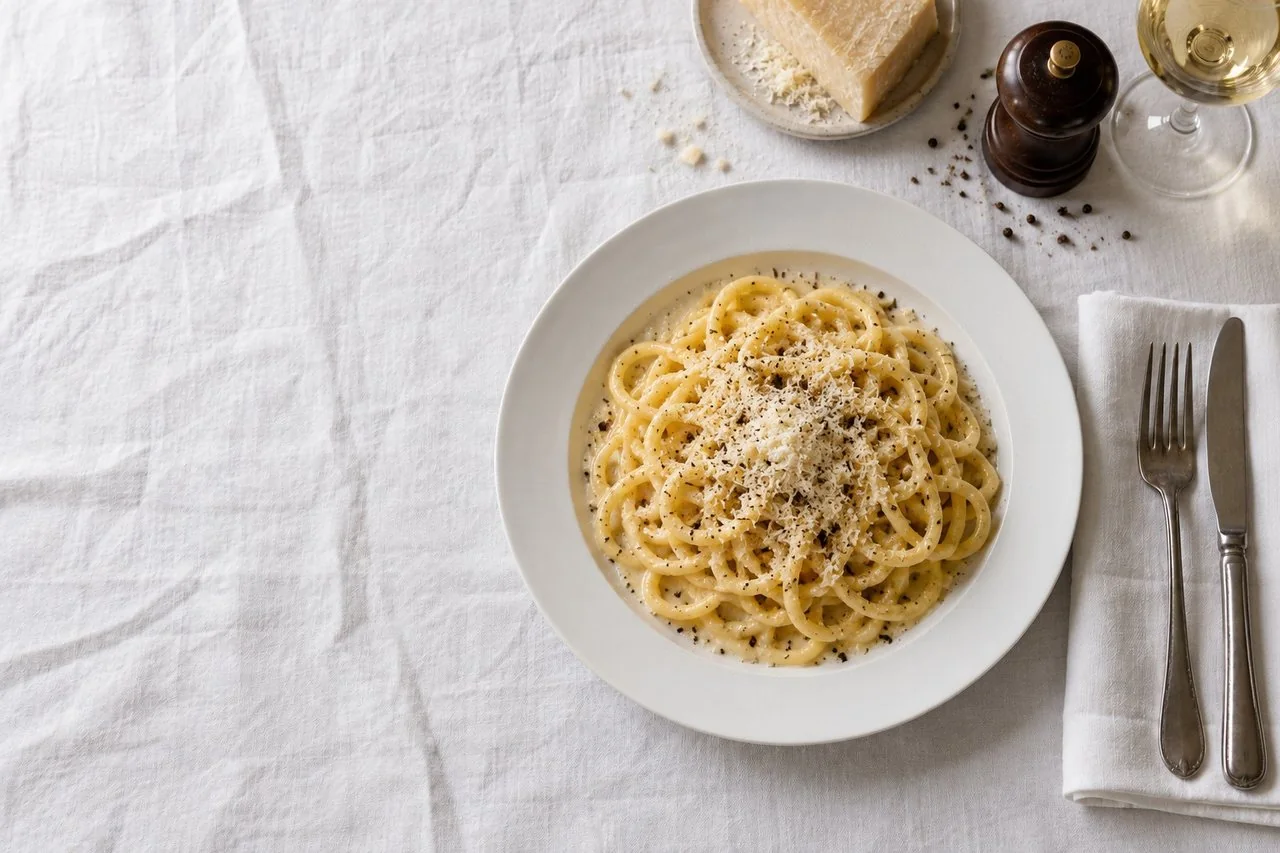
Four published recipes, with their original quantities.
Three recipes come from public tourism portals: Turismo Roma, Italia.it and VisitLazio. The fourth is the «scientific recipe» of a group of physicists, published in Physics of Fluids. Per 100 g of pasta, the pecorino ranges from 25 to 66.7 g; the median is 37.5 g, or 150 g for 400 g of pasta.
| Recipe (source) | Pasta | Pecorino | Pasta cooking water | Pepper and other | Pecorino per 100 g of pasta |
|---|---|---|---|---|---|
| Turismo Roma (City of Rome) | 400 g spaghetti, serves 4 | 100 g grated Pecorino Romano DOP | «A scant ladle» | Black pepper; salted water | 25 g |
| Italia.it, Italy’s official tourism portal | 400 g tonnarelli, serves 4 | 150 g Pecorino Romano DOP | 100 g | Ground black pepper to taste | 37.5 g |
| VisitLazio (Lazio Region) | 400 g spaghetti, serves 4 | 150 g Pecorino Romano | About 100 g | Freshly ground black pepper | 37.5 g |
| Physics of Fluids study, 2025 | 300 g pasta for 2 hungry people (tonnarelli, or spaghetti or rigatoni) | 200 g cheese (only Pecorino Romano DOP for traditionalists) | 150 g water with 5 g starch, plus cooking water as needed | Toasted black pepper; lightly salted pasta water | 66.7 g |
Quantities read on 20 October 2026 (Turismo Roma and Italia.it in Italian). The study is Bartolucci et al., «Phase behavior of Cacio e Pepe sauce», Physics of Fluids 37, 044122 (2025). Median of the four sources: 37.5 g of pecorino per 100 g of pasta.
Work out the quantities for your pasta.
Enter how much pasta you are cooking and pick a recipe: pecorino, water and, for the study, starch scale in proportion. For the traditional recipes the calculator also shows how much starch to add if the sauce clumps, 2 to 3% of the pecorino. It is arithmetic on the published quantities: taste and adjust the pepper.
How to make it, with pasta water.
1. The pecorino. Grate it into a large bowl with the black pepper, freshly ground or crushed, as Turismo Roma does.
2. The pasta. Cook it in lightly salted water, because pecorino is already salty. VisitLazio drains it a couple of minutes early: it finishes cooking with the sauce.
3. The sauce. Mix the pecorino with about the same weight of hot pasta water, below 65 °C, until smooth (VisitLazio).
4. Together. Toss pasta and sauce quickly, adding pasta water a spoonful at a time if needed. Serve at once, on a warm plate, with more black pepper.
Why it clumps: what the physicists measured.
In 2025 a group of physicists from the universities of Barcelona and Padua and the Max Planck Institute in Dresden (Bartolucci et al.) published a study of cacio e pepe sauce in Physics of Fluids. Heating pecorino, water and starch, they found that starch matters most: below 1% of the cheese weight the sauce separates into a single clump, the phase they call «Mozzarella»; above 4% it turns stiff as it cools; between 2 and 3% it stays smooth.
Their recipe for two hungry people: 300 g of pasta and 200 g of cheese. Dissolve 5 g of corn or potato starch in 50 g of water and heat it until it turns from cloudy to almost clear; add another 100 g of water, blend in the cheese and add pepper toasted in a pan. Drain the pasta al dente and let it cool for up to a minute before tossing. According to the authors, pasta water alone does not hold enough starch.
Instead of starch they suggest 5 g of trisodium citrate, which is not part of the tradition and slightly dulls the cheese flavour. The study is free to read on arXiv.
Spaghetti or tonnarelli? And Parmigiano?
Turismo Roma names spaghetti as the pasta of the original recipe and lists rigatoni, tonnarelli and egg pasta such as tagliolini and spaghetti alla chitarra among the variants. Italia.it uses tonnarelli; the study prefers them but says spaghetti or rigatoni work too.
On the cheese VisitLazio is firm: the «cacio» has to be Pecorino Romano DOP. The study’s authors report that traditionalists use only pecorino, while others accept up to 30% Parmigiano Reggiano DOP, still a point of debate. Rome’s other pecorino dishes are in our guide to traditional Roman dishes.
Before you visit
How much pecorino per person for cacio e pepe?
With 100 g of pasta each, the published recipes use 25 g (Turismo Roma) to 37.5 g (VisitLazio and Italia.it) of Pecorino Romano. The Physics of Fluids study uses 100 g per person, with 150 g of pasta.
How much pasta water do you need?
VisitLazio and Italia.it give about 100 g for 400 g of pasta, and VisitLazio melts the pecorino in a similar weight of hot water, below 65 °C. Turismo Roma says «a scant ladle».
Why does cacio e pepe clump?
Heat makes the cheese proteins stick together. According to the study published in Physics of Fluids in 2025, if starch is less than 1% of the cheese weight the sauce separates; at 2 to 3% it stays smooth. Pasta water alone, the authors write, does not contain enough.
Can you use Parmigiano in cacio e pepe?
For VisitLazio the cheese has to be Pecorino Romano DOP. The study’s authors report that traditionalists use only pecorino and that others accept up to 30% Parmigiano Reggiano DOP: it is a debated point.
Spaghetti or tonnarelli?
Turismo Roma names spaghetti as the original pasta and tonnarelli as a variant; Italia.it and the study use tonnarelli. At La Lupa cacio e pepe comes with tonnarelli.
Where to eat cacio e pepe near Termini?
At La Lupa, Via Marghera 37, about a hundred metres from the Via Marsala exit: tonnarelli cacio e pepe à la carte, kitchen open 12:00–23:00. Details on cacio e pepe near Termini.